Our Approach
We back young people in underserved schools, equipping them to turn discomfort into learning, and learning into value for themselves and their communities.
JEP creates a reason to learn
JEP creates a reason to learn. Learners notice something real, ask questions, find the curriculum knowledge they need, choose tools, act, get feedback and improve.
- 1Noticesomething real
- 2Askquestions
- 3Findthe curriculum knowledge they need
- 4Choosetools
- 5Act
- 6Getfeedback
- 7Improve
Each improvement raises a new question, so the loop starts again. See the seven steps in full
Young people in underserved schools, starting at Spectrum Secondary School in Kyangwali Refugee Settlement, where refugee and host-community learners study together.
Teachers who guide, a clear project method (DISCERN, PROMPT, PROTOTYPE, FEEDBACK), and tools and resources inside the school, starting with what is available locally.
Learning that sticks because it is used, and value for the learner, their family and their community.
Doing what is right, not what is easy
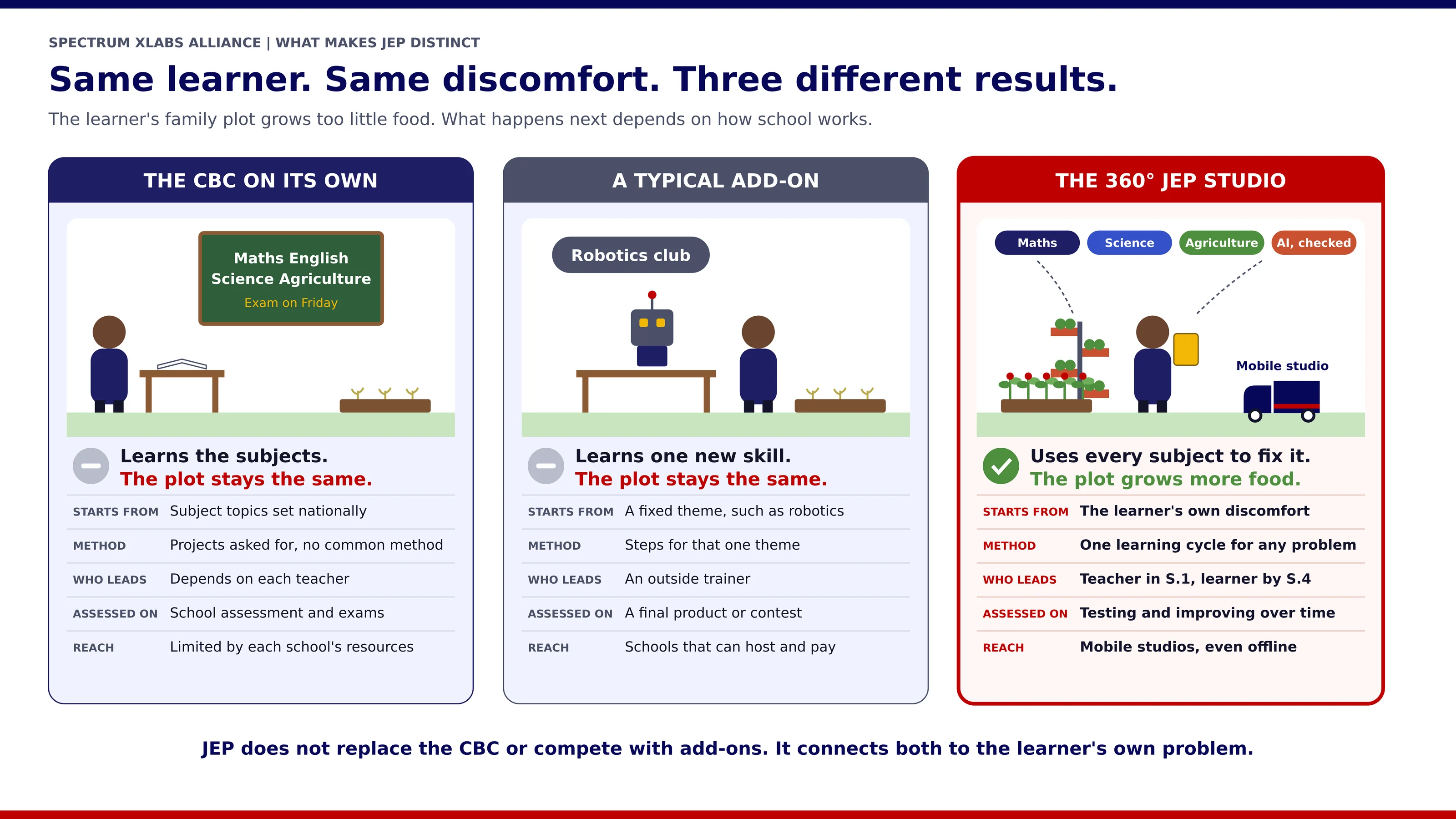
The easy path is the one most schools already follow: the existing curriculum on its own, with technology added on the side. It is easier to run and easier to measure. The right path takes more from everyone, and it is the one JEP takes. JEP works inside Uganda’s national curriculum. It does not replace it, its examinations or its teachers; it gives learners a reason to use what the curriculum teaches.
Where learning starts
The textbook and the exam. A learner’s own challenges, at home or at school, stay outside the classroom.
A discomfort the learner notices in real life, such as a family plot that grows too little food. It becomes a reason to learn.
How knowledge is used
Learned for recall, and often forgotten after the exam.
Curriculum knowledge found when the problem needs it, then used, checked and remembered.
Technology
An add-on: a computer lesson or a club, cut off from the subjects and from the learner’s problem.
A means, not an end. Learners choose tools for the question, including AI, and check what the tools tell them.
The teacher
Covers the syllabus, with little time to link it to learners’ lives.
Remains central: teaches what the project needs when it is needed, asks questions and gives feedback.
What is assessed
Mostly a final written exam that rewards recall.
Reasoning, evidence, testing and improvement, recognised within national curriculum and examination requirements.
What a learner leaves with
Knowledge they can repeat, but are not yet able to use.
Agency: the capacity to notice what matters, ask the right questions, find what they need to know, and act on it.
 Select to enlarge
Our North Star
The opposite of dependence isn’t knowledge, it’s agency.
This is our North Star. Agency isn’t information handed to a learner. It’s the capacity to notice what matters, ask the right questions, find what they need to know, and act on it, so a young person can turn discomfort into value.
See the approach at work
Follow one learner through a full project, see how JEP runs at Spectrum, or read the beliefs behind it.